Forklift Ramp Slope Calculator: Grade, Angle and Ramp Length — 48 Examples
By Uptime Dock & Door Research · Updated September 2026
A forklift ramp's grade is rise ÷ horizontal run × 100: 4 feet up over 40 feet is a 10% grade, or 5.71°, not 10°. At a 48-inch rise, Uptime Dock & Door Research calculates 13.5% to 14.4% for straight, 28- to 30-foot ramp sections modeled from four makers' nominal dimensions, September 2026. See the dimensions and assumptions, or use the forklift ramp slope calculator below.
Forklift ramp slope calculator: how steep is my ramp?
Enter the height your ramp climbs, plus one more measurement: the horizontal run, the length along the ramp surface, a target slope, or a yard ramp's confirmed along-deck dimensions. Overall length and level-off alone are not enough when the drawing's measurement basis is unclear. The calculator returns the grade, the angle, the ratio and both lengths. It works out geometry only; it does not approve a truck, a load or a ramp. Yard-ramp examples use a straight incline and horizontal level-off.
Here's the one thing to get right before you type. "Ramp length" can mean three different numbers. There's the flat distance on the ground (the horizontal run). There's the distance along the ramp surface (the sloped length). And there's the length on a product sheet, which may include a flat top section and a lip. The calculator asks which one you have, because each gives a different answer.
Once you have a result, the calculator puts it next to the published numbers that matter: OSHA's 10% line, the dock equipment makers' limits for your type of truck, California's limits if your site is there, and your truck's own spec-sheet figure if you enter it. It shows the numbers side by side. It never turns them into a pass or a fail.
Calculate the ramp geometry
The calculator runs in your browser. It calculates geometry only; it does not approve a truck, a load or a ramp.
Your numbers stay on your device.
Vertical height the ramp climbs. Zero or more.
Choose a mode to identify whether this is horizontal run, sloped length or overall product length.
Optional reference details
These references are shown as text. They are not pass/fail decisions or operating approvals.
Your truck’s published figure (optional)
Examples: gradeability at a stated speed, maximum gradeability, grade clearance, or “not sure.” Keep the label exactly as printed.
Key forklift ramp slope statistics
- At a 48-inch rise, modeled grades are 13.5% to 14.4% for straight ramp sections 28 to 30 feet long, in Uptime Dock & Door Research's September 2026 calculation from selected Bluff, Copperloy, HandiRamp and Vestil nominal dimensions. These are not measured product grades. Dimensions, sources and assumptions.
- The 35 selected height-and-dimension scenarios calculate to grades from 10.05% to 19.72%. Uptime Dock & Door Research used the four designs' listed minimum and maximum heights plus selected heights inside each range, September 2026. All 35 modeled values exceed 10%; this is not a measurement of installed ramps. Table and method.
- A straight ramp needs 40.20 feet of sloped length to climb 48 inches at a 10% grade. That is 10.20 to 12.20 feet longer than the 28- to 30-foot sections in Uptime Dock & Door Research's nominal-dimension model, September 2026. Calculation.
- 10%: the grade above which federal OSHA requires loaded forklifts to be driven with the load pointing uphill. It is a threshold in this paragraph, not a maximum ramp slope. (29 CFR 1910.178(n)(7)(i), checked September 29, 2026)
- 5.71° vs 17.63%: a 10% grade is 5.71 degrees; a 10-degree ramp is a 17.63% grade. At a 48-inch rise, 10% needs 40.00 feet of run and 10° needs 22.69 feet. (Uptime Dock & Door Research calculation using the USGS method)
- 3% or 7%: the published maximum grade for a hand pallet jack, depending on the source. Poweramp and Chalfant say 3%; Loading Dock Inc. says 7%. (Poweramp; Chalfant, 2023; Loading Dock Inc., 2016; checked September 29, 2026)
- 10% and 15%: Poweramp and Chalfant's published maximum-grade guidance for electric and gasoline forklifts, respectively, at dock transitions. These are publisher recommendations, not universal operating limits. (Poweramp; Chalfant; checked September 29, 2026)
- 26% to 45%: Toyota's computed maximum loaded gradeability for 12 Core IC forklifts rated 3,000 to 6,500 lb. Hyster says its own gradeability figures do not endorse operating on those inclines. (Toyota spec sheet, ©2016; Hyster spec sheet, 2016)
- 35% to 38%: Crown's published "grade clearance, loaded" for 10 FC 5200 electric forklifts. The sheet lists no gradeability figure at all. (Crown spec sheet, Rev. 12-17)
- 1:8 and 1:3: California's maximum slopes for industrial ramps (12.5%) and for ramps used only by powered industrial trucks (33.33%). (8 CCR 3233, checked September 29, 2026)
- 1984: the year OSHA removed paragraph (n)(7)(ii), a grade-travel line it had called advisory in 1976, from the federal forklift rule. Today the spot reads "[Reserved]." (49 FR 5318, item 64; 1976 interpretation)
On this page: Calculator · Yard ramp grades · 10% vs 10° · How to calculate · Ramp length table · OSHA rules · Pallet jack and forklift limits · Gradeability · Clearance at the top · State rules · Other rule scopes · Limits · Method · Cite · Download · FAQ · Sources
How steep are yard ramps at real trailer heights?
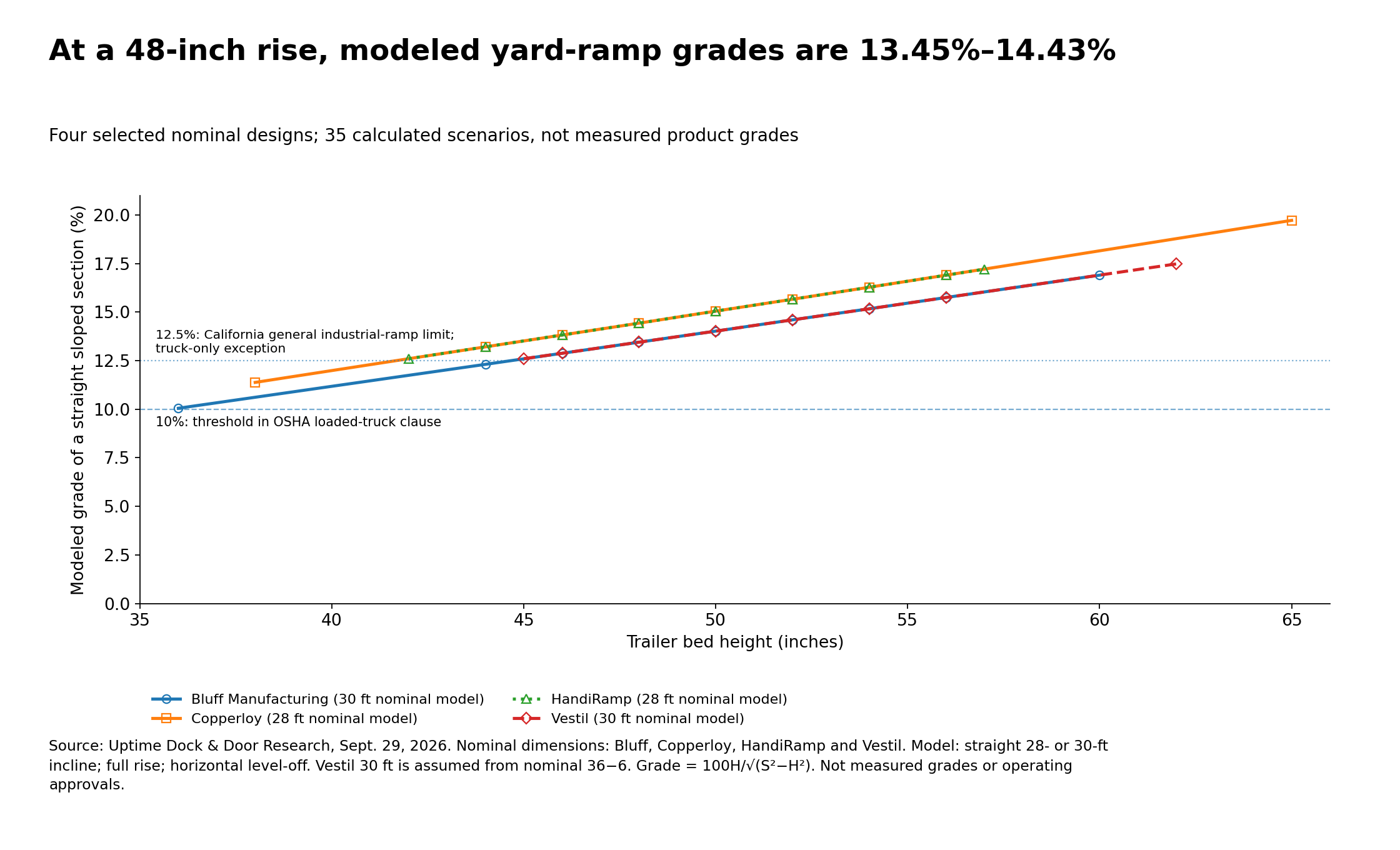
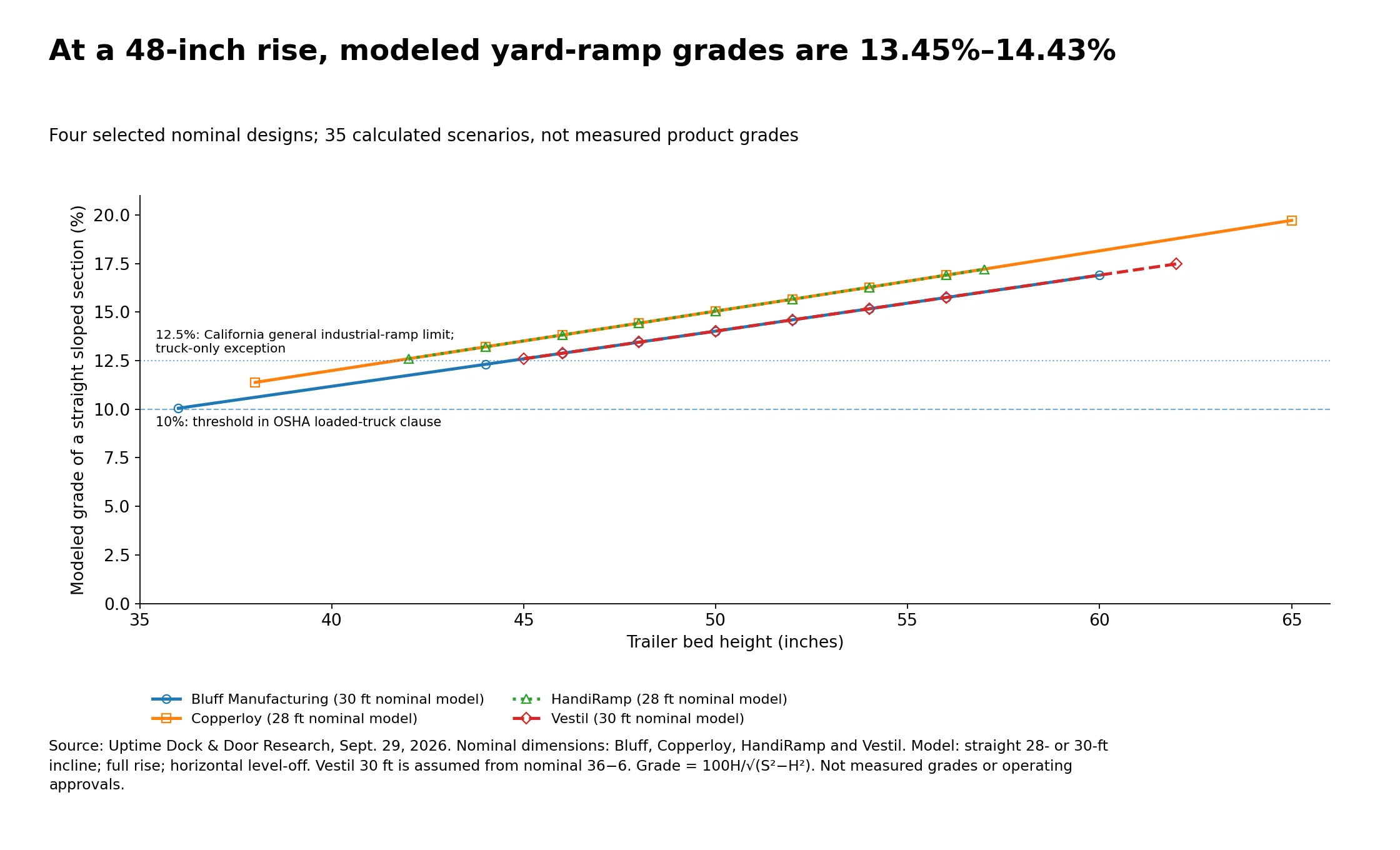
The selected nominal-dimension models calculate to 13.45% to 14.43% at a 48-inch rise. Across 35 scenarios using the four designs' published height ranges, the calculated grades run from 10.05% to 19.72%. These are straight-section calculations, not measured slopes of the products.
A yard ramp is the steel ramp on wheels that lets a forklift drive from the ground up into a trailer when there's no loading dock. The four ground-to-truck designs we selected have a nominal 36-foot overall length. But not all 36 feet slope. Each has a 6- or 8-foot "level-off" at the top. Our model treats that section as horizontal and assigns the full rise to a straight 28- or 30-foot incline. The exact lip, toe and deck profile still matter on an actual ramp.
Say your trailer bed sits 48 inches off the ground. Chalfant, a dock equipment maker, describes 48 to 52 inches as a typical dock-height range—not a measured national average (Chalfant). Climb 48 inches over 30 feet of ramp, and you get a 13.45% grade. Climb it over 28 feet, and it's 14.43%. Both modeled values exceed the 10% threshold in OSHA's loaded-truck clause; neither calculation establishes the grade of an installed ramp.
Scroll horizontally to view all columns.
| Bed height | Bluff MobilePRO+ (30 ft slope) | Copperloy SYR (28 ft slope) | HandiRamp ITZ (28 ft slope) | Vestil YR (nominal 30 ft model) |
|---|---|---|---|---|
| Lowest listed height | 10.05% at 36 in | 11.38% at 38 in | 12.60% at 42 in | 12.60% at 45 in |
| 44 in | 12.31% | 13.21% | 13.21% | — |
| 46 in | 12.88% | 13.82% | 13.82% | 12.88% |
| 48 in | 13.45% | 14.43% | 14.43% | 13.45% |
| 50 in | 14.02% | 15.05% | 15.05% | 14.02% |
| 52 in | 14.60% | 15.66% | 15.66% | 14.60% |
| 54 in | 15.17% | 16.28% | 16.28% | 15.17% |
| 56 in | 15.75% | 16.90% | 16.90% | 15.75% |
| Highest listed height | 16.90% at 60 in | 19.72% at 65 in | 17.21% at 57 in | 17.48% at 62 in |
Source: Uptime Dock & Door Research calculation from published dimensions: Bluff MobilePRO+ (36 ft with 6 ft level-off, 36–60 in); Copperloy SYR16-84-36PL8 (36 ft, 8 ft level-off, 38–65 in); HandiRamp ITZ (28 ft incline, 8 ft level-off, 42–57 in); Vestil YR-20-8536 drawing (36 ft, 6 ft level-off, 45–62 in). Grade = tan(asin(bed height ÷ sloped section)) × 100. Checked September 29, 2026. A dash means the height is outside that maker's listed range. The model assumes a straight incline, full stated rise and horizontal level-off. Vestil's 30 feet is the nominal 36-minus-6 calculation; its drawing also gives an actual 429 9/16-inch overall dimension, a 16-inch lip and toe detail. No separate 30-foot sloped-surface dimension was confirmed. The two decimal places show arithmetic, not measurement precision.
Three things make this table more useful than a spec sheet. First, it gathers the same height-based calculation for four selected designs in one place. Second, it shows exactly what we assumed: one straight sloped section and a horizontal level-off. It is not a "gentlest-case" bound; lips, toes, deck tilt and measurement basis can change the result. Third, the two nominal slope lengths split cleanly. At a 48-inch rise, a 30-foot section calculates to 0.98 percentage points less grade than a 28-foot section. That gap changes with height.
View supplied chart image
Why the flat top section makes the slope steeper
The level-off does a real job. It provides a top section for entering the trailer. In our model, that section is horizontal and comes out of the same nominal 36 feet. An 8-foot level-off leaves 28 feet to climb; a 6-foot level-off leaves 30. In the straight-section model, that 2-foot difference gives a 0.98-percentage-point gap at a 48-inch rise.
How long would a yard ramp need to be to stay at 10%?
About 40.2 feet of straight slope for a 48-inch rise. That's 10.2 to 12.2 feet more than the 28- to 30-foot nominal sections modeled here. Add a 6- or 8-foot level-off and you're looking at a ramp around 46 to 48 feet long overall, before counting the lip. Bluff notes that shorter ramps mean steeper grades and offers lengths up to 50 feet (Bluff).
The plain takeaway: "36 feet overall" is not enough to calculate a yard ramp's slope. Identify the sloped section and the actual rise. The models here all exceed 10%, but a real-ramp assessment needs the actual profile, setup and equipment instructions.
Is a 10% grade the same as 10 degrees?
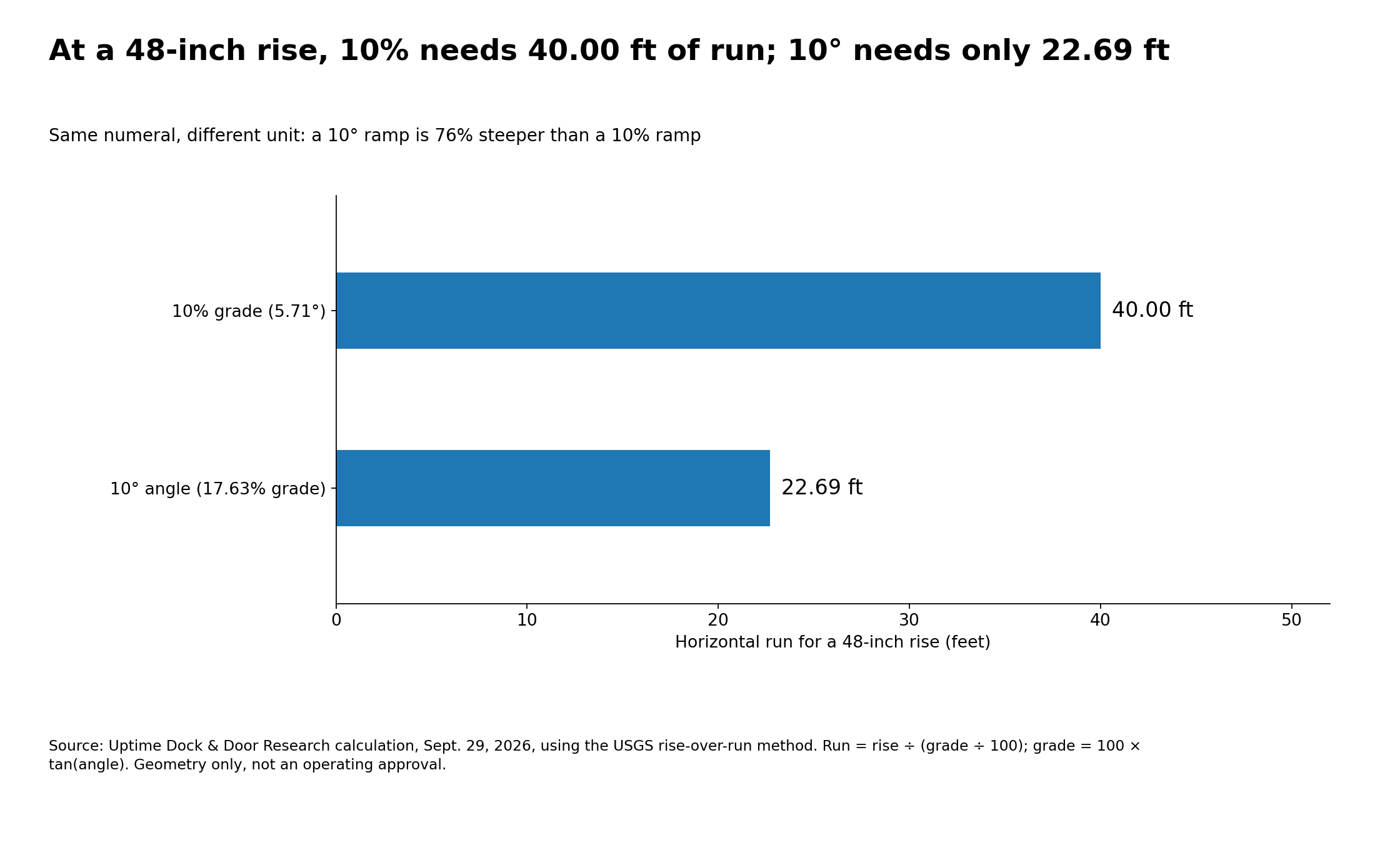
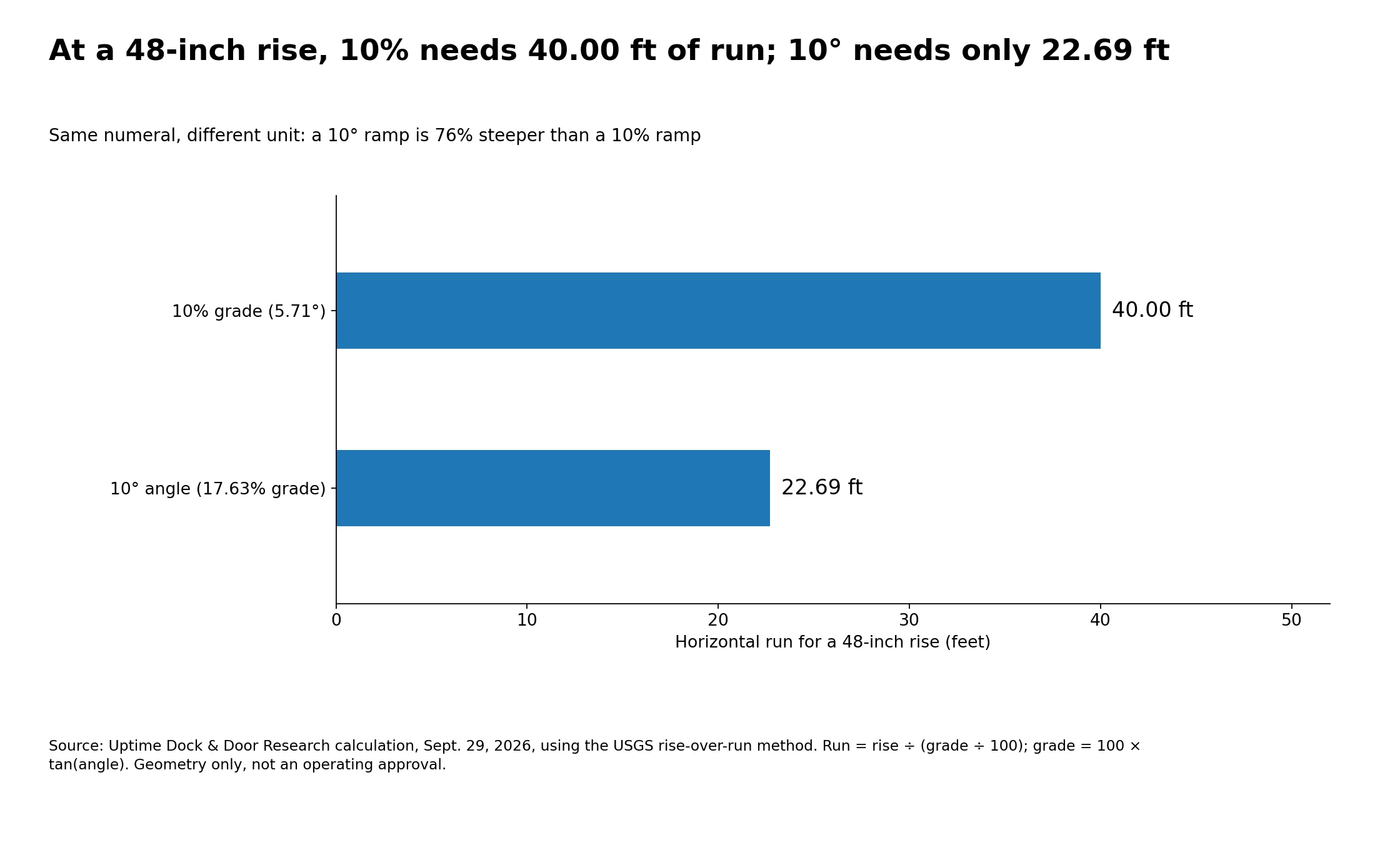
No. A 10% grade is 5.71 degrees, and a 10-degree ramp is a 17.63% grade, about 76% steeper. At a 48-inch rise, a 10% grade needs 40.00 feet of horizontal run, while a 10-degree slope needs only 22.69 feet.
Percent and degrees both describe steepness, but they count it differently. Percent grade asks: how many feet up for every 100 feet across? Degrees measure the angle between the ramp and the flat ground. At small slopes, the two numbers look close enough to swap. They aren't. Swap them at 10 and you've nearly doubled the steepness.
The units matter in the rule too. OSHA's forklift paragraph says "10 percent", not 10 degrees. The separate construction scaffold rule prints both 1:3 and 20 degrees; those are not exact mathematical equivalents. The forklift provision is 29 CFR 1910.178(n)(7)(i).
Scroll horizontally to view all columns.
| Entered as | Grade | Angle | Horizontal run | Sloped length |
|---|---|---|---|---|
| 10% grade | 10.00% | 5.71° | 40.00 ft | 40.20 ft |
| 10° angle | 17.63% | 10.00° | 22.69 ft | 23.04 ft |
Source: Uptime Dock & Door Research calculation, September 29, 2026, using the USGS percent-slope method. Run = rise ÷ (grade ÷ 100); grade = 100 × tan(angle). Geometry only.
View supplied chart image
Why multiplying by 100 doesn't give you degrees
Rise ÷ run × 100 gives you percent. To get degrees you need one more step: the inverse tangent, the "tan⁻¹" or "INV TAN" key on a calculator. The U.S. Geological Survey teaches it exactly that way (USGS). So 12 inches up over 120 inches across is 0.1. Times 100, that's 10%. The inverse tangent of 0.1 is 5.71°.
Scroll horizontally to view all columns.
| Grade | Angle | Ratio (rise:run) | Run per foot of rise | Run for a 48-in rise | Sloped length for a 48-in rise | Where this grade appears |
|---|---|---|---|---|---|---|
| 3% | 1.72° | 1:33.33 | 33.33 ft | 133.33 ft | 133.39 ft | Hand pallet truck guidance (Poweramp; Chalfant) |
| 5% | 2.86° | 1:20 | 20.00 ft | 80.00 ft | 80.10 ft | — |
| 7% | 4.00° | 1:14.29 | 14.29 ft | 57.14 ft | 57.28 ft | Powered pallet truck guidance (Poweramp; Chalfant); manual pallet truck guidance (Loading Dock Inc.) |
| 8.33% | 4.76° | 1:12 | 12.00 ft | 48.00 ft | 48.17 ft | ADA general ramp-run limit, 1:12; limited existing-site exceptions |
| 10% | 5.71° | 1:10 | 10.00 ft | 40.00 ft | 40.20 ft | OSHA clause applies above 10%, not at 10%; electric forklift guidance (Poweramp; Chalfant) |
| 12% | 6.84° | 1:8.33 | 8.33 ft | 33.33 ft | 33.57 ft | — |
| 12.5% | 7.13° | 1:8 | 8.00 ft | 32.00 ft | 32.25 ft | California 8 CCR 3233(c) industrial ramp maximum, 1:8 |
| 14% | 7.97° | 1:7.14 | 7.14 ft | 28.57 ft | 28.85 ft | — |
| 15% | 8.53° | 1:6.67 | 6.67 ft | 26.67 ft | 26.96 ft | Gasoline guidance (Poweramp; Chalfant); IC guidance (Loading Dock Inc.) |
| 20% | 11.31° | 1:5 | 5.00 ft | 20.00 ft | 20.40 ft | — |
| 25% | 14.04° | 1:4 | 4.00 ft | 16.00 ft | 16.49 ft | — |
| 30% | 16.70° | 1:3.33 | 3.33 ft | 13.33 ft | 13.92 ft | — |
| 33.33% | 18.43° | 1:3 | 3.00 ft | 12.00 ft | 12.65 ft | California 3233 limit for ramps used only by powered industrial trucks, 1:3 |
| 8.75% | 5.00° | 1:11.43 | 11.43 ft | 45.72 ft | 45.89 ft | 5-degree reference row |
| 17.63% | 10.00° | 1:5.67 | 5.67 ft | 22.69 ft | 23.04 ft | 10-degree reference row |
| 26.79% | 15.00° | 1:3.73 | 3.73 ft | 14.93 ft | 15.45 ft | 15-degree reference row |
| 36.40% | 20.00° | 1:2.75 | 2.75 ft | 10.99 ft | 11.70 ft | 20-degree reference row |
Source: Uptime Dock & Door Research calculation, September 29, 2026. Angle = atan(grade ÷ 100), in degrees. Ratio is rise:run. The 1:12 and 1:3 rows use those exact ratios; the four degree rows use exact entered angles. Do not recompute from a rounded grade. All 48-inch examples are geometry only, not accessible-route designs. The last column shows which published rule or guideline uses that grade; see Table 7, Table 9 and Table 10 for the sources.
How do you calculate a ramp's grade, angle and length?
Put both measurements in the same unit, then divide the rise by the horizontal run and multiply by 100 to get percent grade. The angle is the inverse tangent of rise ÷ run. The length along the ramp surface is the square root of rise squared plus run squared.
Scroll horizontally to view all columns.
| To find | Formula | Worked example (units stated; the angle example uses 10°) |
|---|---|---|
| Grade (%) | rise ÷ run × 100 | 4 ÷ 40 × 100 = 10% |
| Angle (degrees) | atan(rise ÷ run) | atan(0.1) = 5.71° |
| Sloped length | √(rise² + run²) | √(4² + 40²) = 40.20 ft |
| Run from grade | rise ÷ (grade ÷ 100) | 4 ÷ 0.10 = 40 ft |
| Run from angle | rise ÷ tan(angle) | 4 ÷ tan(10°) = 22.69 ft |
| Run from sloped length | √(sloped length² − rise²) | √(40.199502…² − 4²) ≈ 40.00 ft |
| Ratio | 1 : (run ÷ rise) | 1:10 |
Source: USGS percent-slope and angle method; right-triangle geometry. 1 inch = 2.54 cm (NIST).
Mixed units can change the answer twelvefold
Convert first. A 48-inch rise over a 40-foot run is not 48 ÷ 40. It's 48 inches ÷ 480 inches, which is 10%. Divide those inches by those feet without converting and you get 120%—12 times the correct answer.
Ground length or ramp length? It depends on your tape measure
The horizontal run is the flat distance on the ground between the two ends of the slope. The sloped length is what you'd measure by laying a tape along the ramp surface. Use the measurement your drawing or records actually gives; do not enter an active ramp to take it.
At forklift slopes, the gap between the two is small. Take an 18-inch rise. Over 180 inches of horizontal run, that's exactly 10%. Over 180 inches of ramp surface, it's 10.05%. So the mix-up here costs you a twentieth of a point. The 10%-versus-10° mix-up above changes grade by 7.63 percentage points. Both examples show why the unit belongs beside the number.
Ratios: which number comes first?
A ratio like 1:8 means 1 unit up for every 8 units across. That's 12.5%, not 8%. Some guides flip the order or count along the ramp surface. When you see a ratio, check which way it's written.
How long does a ramp need to be for my height?
At a 10% grade, a ramp needs 10 feet of horizontal run for every foot it climbs. A 12-inch rise needs 10 feet, and a 48-inch rise needs 40 feet. Halving the grade doubles the run: at 5%, that same 48-inch rise needs 80 feet.
The grades below are example inputs, not recommendations. Use them to see how much floor space a slope costs. Check your equipment's limit in the next sections.
Scroll horizontally to view all columns.
| Rise | 5% | 8% | 10% | 12.5% | 15% | 20% |
|---|---|---|---|---|---|---|
| 6 in | 10.00 ft | 6.25 ft | 5.00 ft | 4.00 ft | 3.33 ft | 2.50 ft |
| 12 in | 20.00 ft | 12.50 ft | 10.00 ft | 8.00 ft | 6.67 ft | 5.00 ft |
| 18 in | 30.00 ft | 18.75 ft | 15.00 ft | 12.00 ft | 10.00 ft | 7.50 ft |
| 24 in | 40.00 ft | 25.00 ft | 20.00 ft | 16.00 ft | 13.33 ft | 10.00 ft |
| 36 in | 60.00 ft | 37.50 ft | 30.00 ft | 24.00 ft | 20.00 ft | 15.00 ft |
| 48 in | 80.00 ft | 50.00 ft | 40.00 ft | 32.00 ft | 26.67 ft | 20.00 ft |
| 54 in | 90.00 ft | 56.25 ft | 45.00 ft | 36.00 ft | 30.00 ft | 22.50 ft |
| 60 in | 100.00 ft | 62.50 ft | 50.00 ft | 40.00 ft | 33.33 ft | 25.00 ft |
Source: Uptime Dock & Door Research calculation, September 29, 2026. Run = rise ÷ (grade ÷ 100). Sloped lengths and metric values for all 48 combinations are in the length reference download. Geometry only; these grades are examples, not recommended slopes.
Say you're adding a concrete ramp from a 24-inch pad down to a yard. At 10%, it needs 20 feet of run. At 15%, it needs 13.33 feet. Those 6.67 feet are the price of the gentler slope.
What does OSHA require for forklifts on ramps?
In 29 CFR 1910.178(n)(7)(i), federal OSHA requires loaded trucks on grades over 10% to be driven with the load pointing uphill. The rule also requires slow travel on all grades, load tilt-back if applicable, and only enough lift to clear the surface. An unattended truck on an incline requires blocked wheels. The cited grade paragraph does not set a maximum ramp slope.
Scroll horizontally to view all columns.
| Rule | What it says, in plain words |
|---|---|
| 1910.178(n)(7) | Go up and down grades slowly. |
| 1910.178(n)(7)(i) | On grades over 10%, drive loaded trucks with the load upgrade (pointing uphill), going up or down. |
| 1910.178(n)(7)(ii) | [Reserved]. The text was removed in 1984. |
| 1910.178(n)(7)(iii) | On all grades, tilt the load back if applicable, and raise it only enough to clear the surface. |
| 1910.178(m)(5)(i) | An unattended truck gets forks down, controls neutral, power off and brakes set. Block the wheels if it's parked on an incline. |
| 1910.178(m)(7) | Set brakes and put wheel blocks in place so trucks, trailers or railroad cars can't move while being loaded or unloaded. |
| 1910.178(n)(11) | Secure dockboards before driving over them, drive over them carefully and slowly, and never exceed their rated capacity. |
| 1910.178(l)(3)(ii)(G) | Operator training covers ramps and other sloped surfaces that could affect stability, unless the employer demonstrates the topic does not apply to safe operation in that workplace. |
Source: 29 CFR 1910.178, official text, checked September 29, 2026. Paraphrased; read the rule for exact wording.
Which way should the forks point on a ramp?
Loaded, on a grade over 10%: the load points uphill, whether you're going up or down. So you drive up forward and back down in reverse. That part is regulation.
Unloaded: OSHA's training eTool says to drive with the forks pointing downgrade (OSHA eTool). That's OSHA guidance, and Toyota's forklift blog says the same (Toyota). The current grade paragraph does not state a separate empty-truck direction rule. Trucks with attachments can require partly-loaded treatment even without a carried load; see 1910.178(o)(4).
Why paragraph (n)(7)(ii) says "[Reserved]"
The grade rules used to have a second paragraph. In an archived 1976 memorandum, OSHA told its staff that paragraph (n)(7)(ii) was advisory: "a general recommendation for improved vision and comfort of the operator," not a requirement like (n)(7)(i) (OSHA interpretation, Nov. 12, 1976). On February 10, 1984, OSHA revoked 153 provisions in its advisory-and-repetitive-standards action, and (n)(7)(ii) was one of them (49 FR 5318, item 64). The current text marks the spot "[Reserved]."
So if a training quiz cites 1910.178(n)(7)(ii) as a rule you must follow, it's pointing at text that's been gone for over 40 years. For empty trucks on grades, OSHA's eTool and your truck's manual are the places to look.
Does OSHA set a maximum slope for forklift ramps?
Not in the cited federal forklift grade paragraph. It gives a travel-rule threshold, not a maximum ramp slope. The "1:3 (20 degrees)" limit that sometimes shows up in forklift articles comes from a different rule: construction scaffold access ramps and walkways, which are for people (29 CFR 1926.451(e)(5)(ii)). One more wrinkle: 1 vertical to 3 horizontal is actually 18.43°, not 20°.
Your ramp's slope still has to fit the truck. Check the actual truck and ramp instructions alongside the rules that apply at the site. The publisher guidance below is a reference, not permission to ignore either. The trailer needs holding too: the same rule calls for trailer brakes set and wheel blocks in place while a forklift loads or unloads it, under 1910.178(m)(7). For how chocks and dock locks compare, see wheel chocks and vehicle restraints compared.
What slope can pallet jacks and forklifts handle?
Poweramp and Chalfant publish 10% maximum-grade guidance for electric forklifts and 15% for gasoline forklifts. For pallet jacks, the sources disagree: 3% or 7% for a hand pallet jack, and 7% or 10% for a powered one. These figures guide dock leveler choices; they do not replace the actual equipment instructions or applicable rules.
Scroll horizontally to view all columns.
| Equipment | Poweramp | Chalfant | Loading Dock Inc. |
|---|---|---|---|
| Hand / manual pallet jack | 3% | 3% | 7% |
| Powered / electric pallet jack | 7% | 7% | 10% |
| Low-lift pallet truck | 10% | — | — |
| Electric forklift | 10% | 10% | — |
| Gasoline forklift / IC category | 15% gasoline | 15% gasoline | 15% IC |
Sources: Poweramp, Grade Chart for Dock Levelers ("maximum recommended grades"); Chalfant, Loading Dock Height (page modified May 2023; "maximum grade capability"); Loading Dock Inc. (December 2016; "normal maximum grade"). Checked September 29, 2026. A dash means the source lists no figure for that category. Poweramp and Chalfant say gasoline; Loading Dock Inc. uses the broader internal-combustion category. Similar numbers do not establish identical equipment scope.
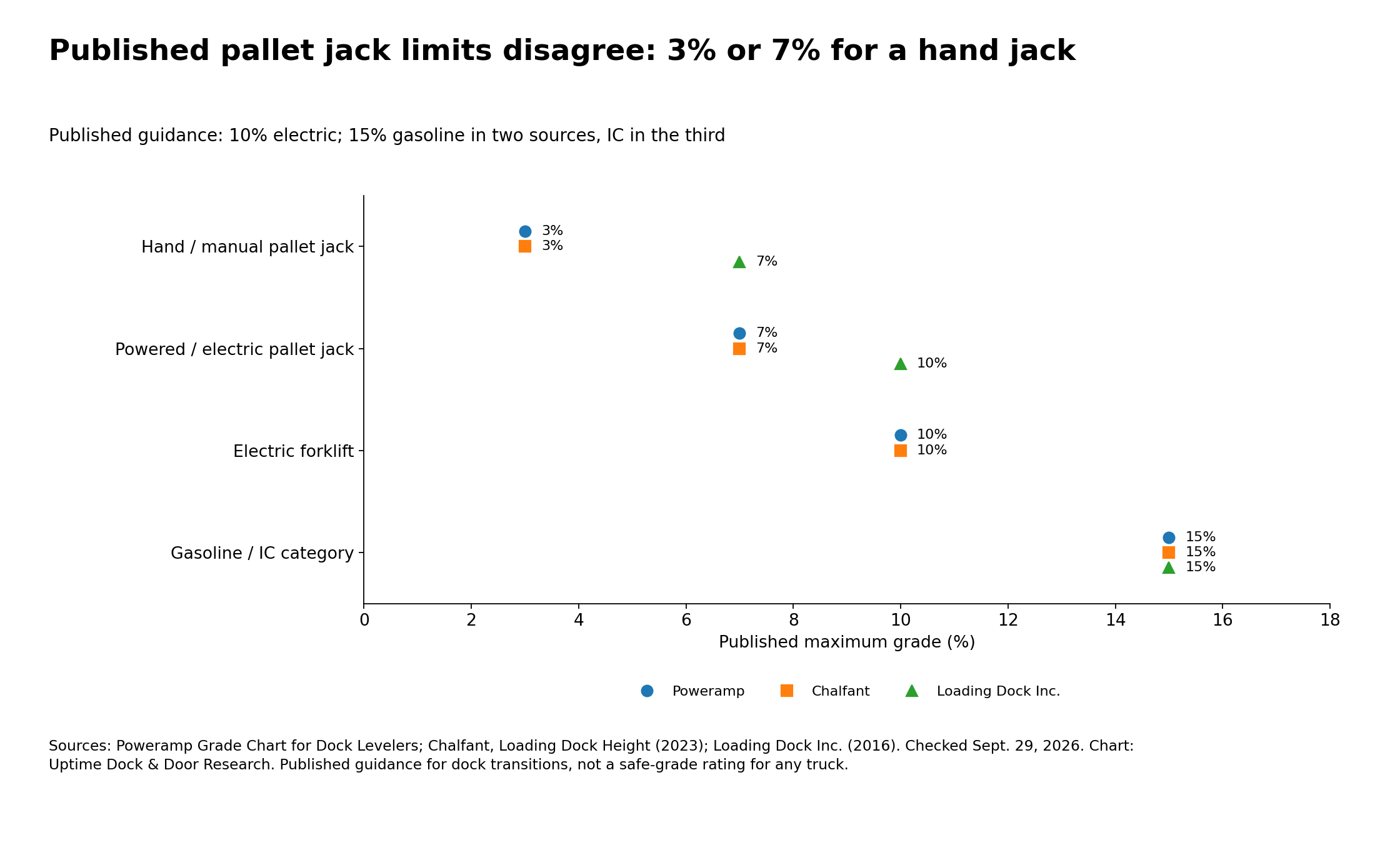
View supplied chart image
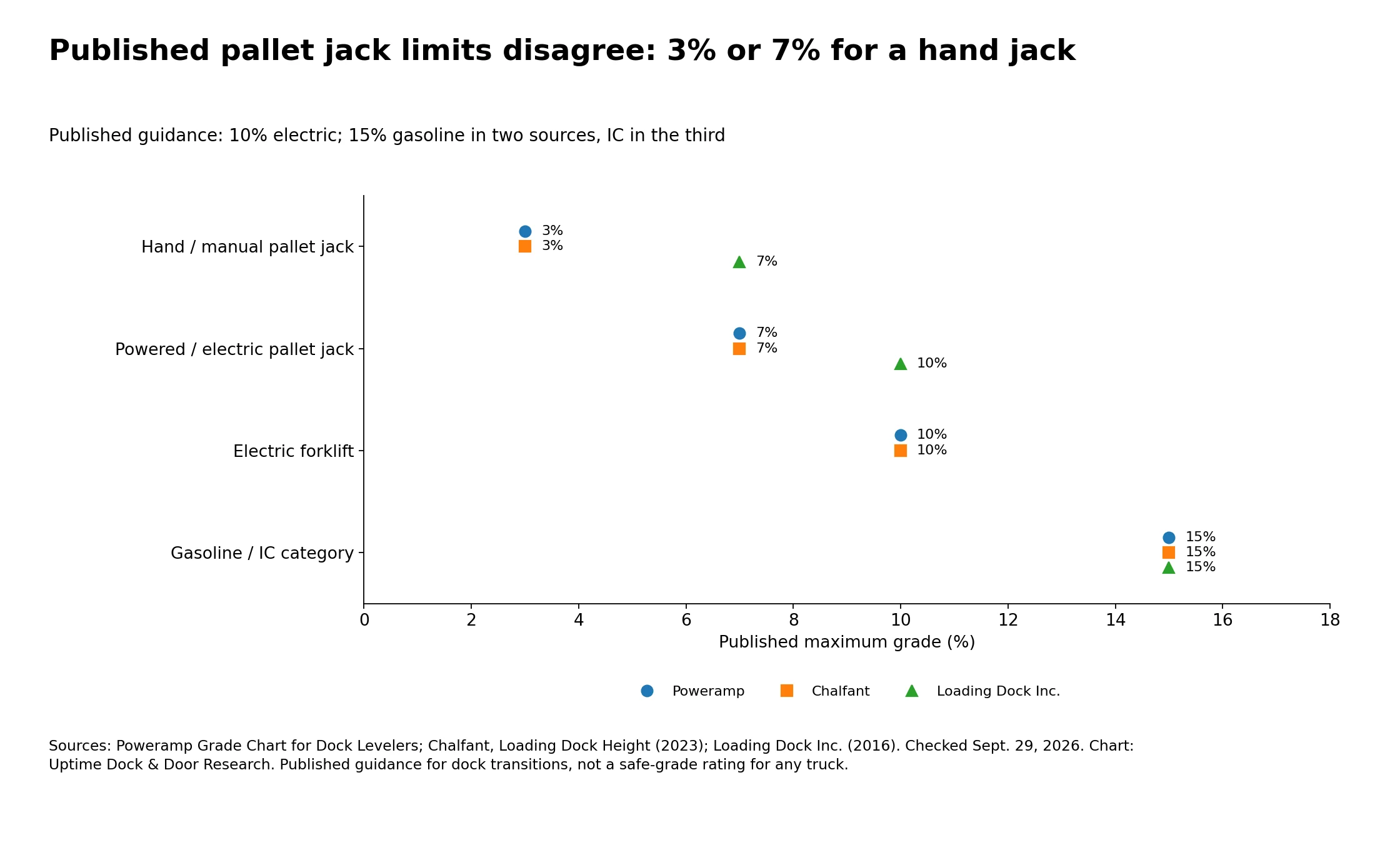
Why the pallet jack numbers disagree
We found two published sets of guidance across three sources. The cited pages do not explain a shared test method that would make the figures interchangeable. One ladder (Poweramp, Chalfant) starts hand jacks at 3%. The other (Loading Dock Inc.) starts them at 7%. That's a gap of more than 2 to 1: one figure represents 3 inches of rise per 100 inches of run, and the other represents 7. That is a numerical comparison, not permission to choose the larger limit.
Here's what that gap means in a dock example. Loading Dock Inc. divides the height difference by the equipment's stated grade, and its 2016 page lists leveler lengths from 5 to 12 feet. Say the trailer sits 5 inches below your dock. At 3%, the geometry needs about 13.9 feet of horizontal run, beyond that page's listed range; at 7%, it needs 5.95 feet. Horizontal run is not automatically a product's overall length. If pallet jacks cross your dock, ask the truck and leveler makers for the applicable figure rather than picking the number you like.
Switching from gasoline to electric changes the published guidance
Here's a quiet catch. Poweramp and Chalfant's published figure drops from 15% for gasoline forklifts to 10% for electric. So a dock slope below the gasoline guideline can sit above the electric guideline, with nothing about the dock changing. If you're planning that switch, have the dock's full operating range checked for the actual equipment.
Slope is one question. Weight is another. If you're checking a dock leveler, see how much capacity a leveler needs for your forklift.
What yard ramp makers say
Copperloy's yard ramp guidance says forklifts can travel gradients of 5% to 12.5%, that heavier loads should stay at 3% to 5%, and that it's best to stick to a 10% maximum even for lighter loads (Copperloy). Copperloy frames these as guidelines for direct dock-to-truck loading and warns about adding ground slope. They are not a grade-by-height rating for the SYR model in Table 1. Keep that guidance separate from our nominal-dimension calculation; their difference does not establish that a product is approved or unsafe.
What does "gradeability" on a forklift spec sheet mean?
It depends on the maker. The Toyota rows used here print computed maximum gradeability, the selected Hyster rows print gradeability at 4.8 km/h for comparing pulling power, and Crown's FC 5200 sheet prints "grade clearance" instead. None of these figures alone establishes a safe operating slope. Their labels and conditions differ, so this is not a cross-brand performance ranking.
Scroll horizontally to view all columns.
| Maker and sheet | Line as printed | Basis | Loaded | Empty |
|---|---|---|---|---|
| Toyota Core IC Pneumatic, ©2016 (12 models, 3,000–6,500 lb) | Gradeability, maximum | Computed values | 26%–45% | 10%–23% |
| Hyster H2.0-3.0XT, Rev. 01-09/16-TLC (6 selected configurations, 2–3 tonnes) | Gradeability, laden/unladen | At 4.8 km/h (about 3 mph); 2.6L diesel / 2.4L LPG | 12.3%–23.9% | 30.5%–34.6% |
| Crown FC 5200, Rev. 12-17 (10 models, 4,000–6,500 lb) | Grade Clearance, Loaded | A clearance figure, not climbing | 35%–38% | not listed |
Sources: Toyota; Hyster (manufacturer-hosted sheet, six selected engine/model configurations); Crown. Checked September 29, 2026. Toyota's 8FDU18 prints 10% empty. That value is included in the download, range and chart; no manufacturer correction was established. Hyster's issuer-hosted sheet also contains two 3.3L diesel configurations, outside this six-row subset. Their presence means the six-row range is not the range of every configuration on that sheet.
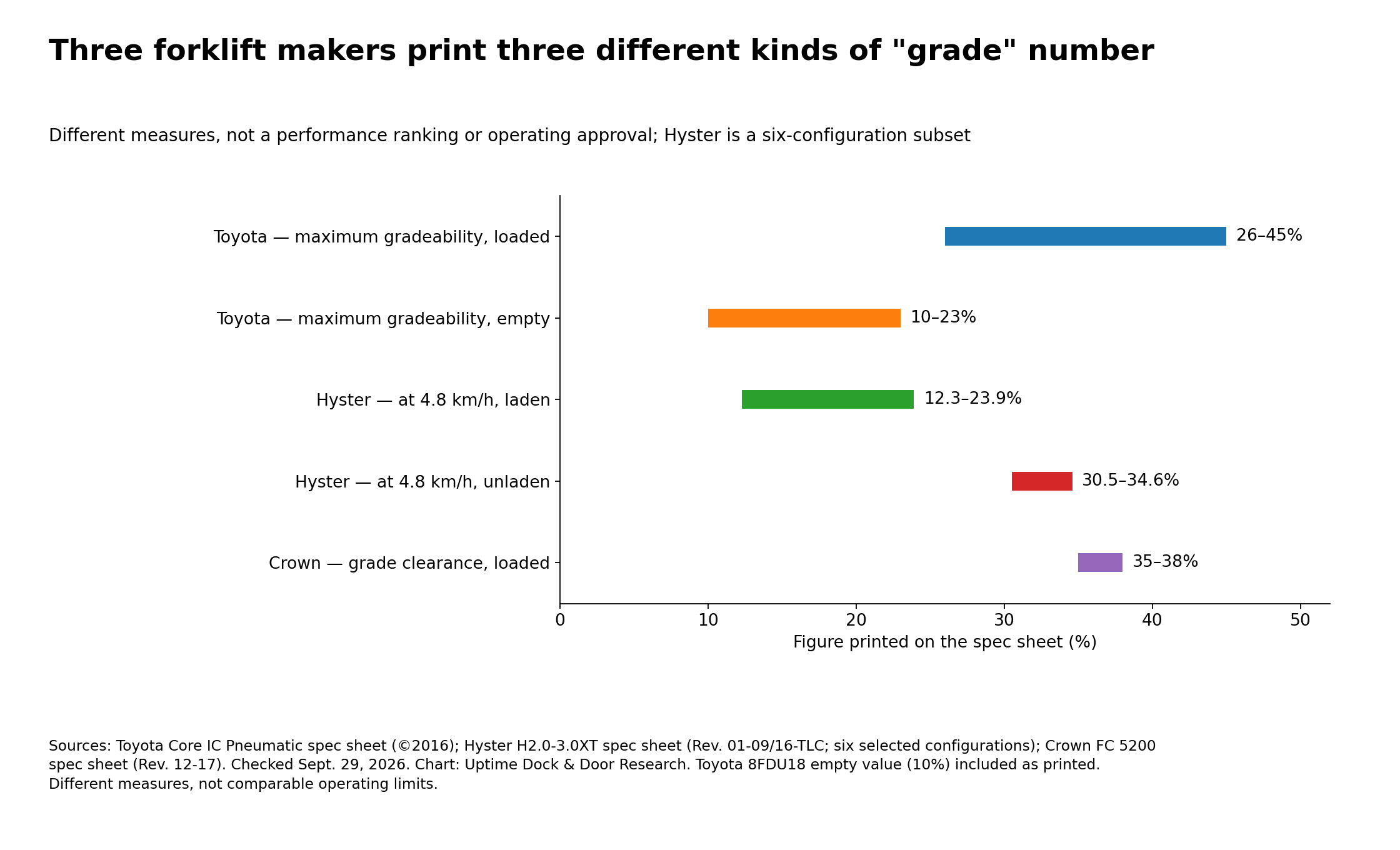
View supplied chart image
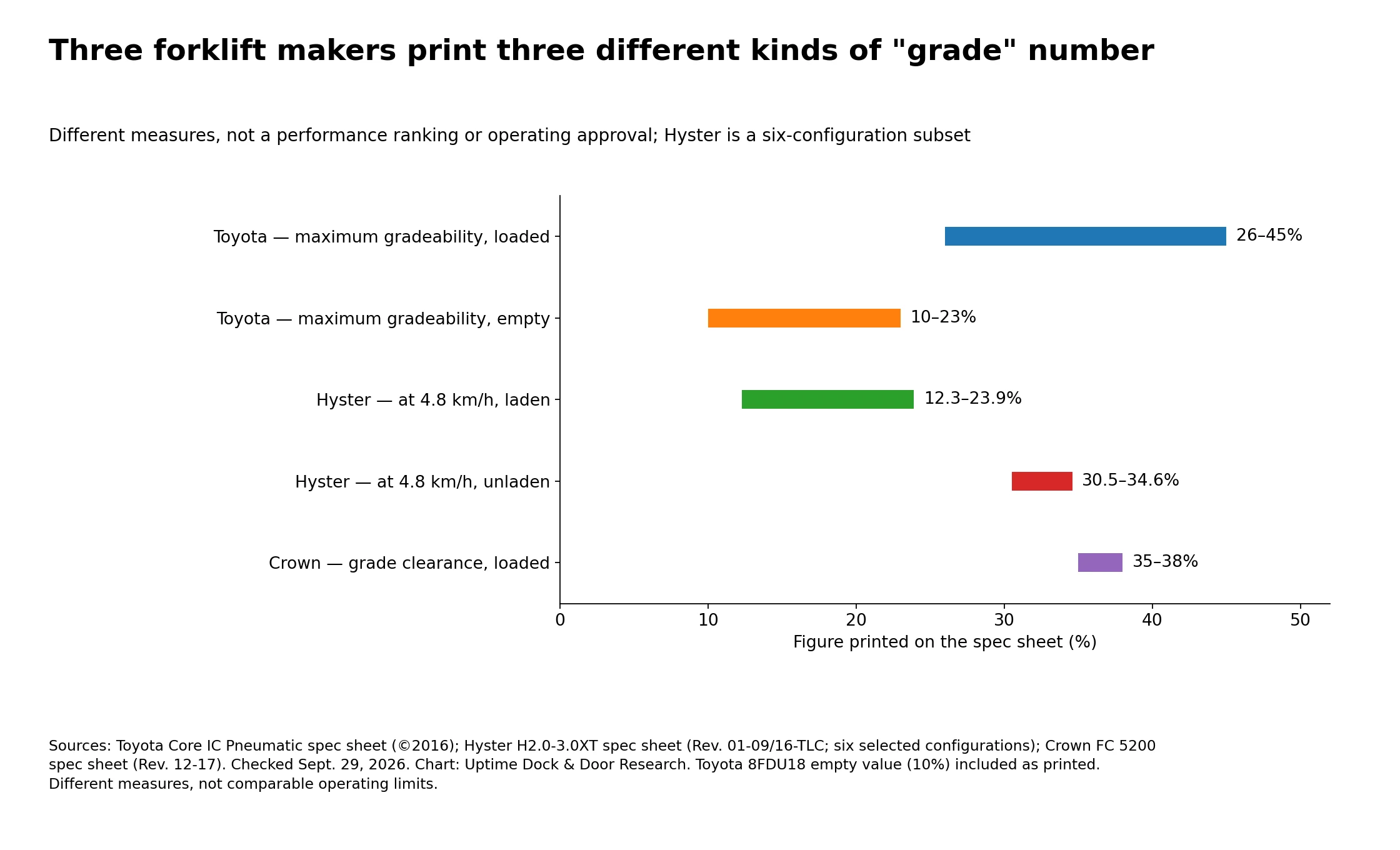
Loaded beats empty on one sheet and loses on the other
Look at the Loaded and Empty columns in Table 8. On Toyota's sheet, every model shows a higher figure loaded than empty. In the six selected Hyster configurations, every row shows the reverse. Same broad kind of truck, opposite pattern. The sheets report different bases: Toyota's selected row is a computed maximum, while Hyster's is stated at a set speed. Toyota also has a separate computed 1 mph row. This comparison does not establish why the loaded-versus-empty patterns differ; the full test and calculation methods are not supplied here.
Is gradeability the steepest ramp my forklift can use?
No. Hyster says it plainly on its own sheet: its gradeability figures are "not intended to endorse the operation of the vehicle on the stated inclines." It tells readers to follow the operating manual instead (Hyster spec sheet). Some ramp guides describe gradeability as the grade a truck can safely climb or descend at full capacity. The maker that prints the number says otherwise.
Will a forklift bottom out at the top of a ramp?
It can, but ramp grade alone does not answer the clearance question. Crown publishes "Grade Clearance, Loaded" of 35% to 38% for these 10 FC 5200 configurations. The sheet does not give a method that turns that row into an allowable crest angle, so we do not make that conversion or claim that a truck clears a ramp.
In our straight-ramp model, the bend into a horizontal level-off equals the ramp angle: 7.66° to 8.21° at a 48-inch rise. That is geometry, not a clearance test. The lowest point matters too, and it isn't always in the middle. For the selected H2.0XT configurations, Hyster's sheet lists 80 mm (about 3.1 inches) below the loaded mast, and 190 mm (about 7.5 inches) at the center of the wheelbase (Hyster). Crown lists 3 inches at the lowest point (Crown). Pallet jacks deserve their own check: Loading Dock Inc. calls pallet jack clearance especially important on edge-of-dock levelers (Loading Dock Inc.).
The calculator keeps your ramp result and any entered grade-clearance figure separately labeled. It does not convert the clearance figure to degrees, estimate bottoming-out clearance or decide whether the truck can cross. That needs the actual truck geometry and the ramp's complete profile, not one percent figure.
Do any states set a maximum forklift ramp slope?
California does. Its rule for industrial ramps caps the slope at 1 vertical to 8 horizontal (12.5%), and at 1:3 (33.33%) for ramps used only by powered industrial trucks. It also requires ramps at least 2 feet wider than the widest vehicle and curbs or equivalent protection on open sides. Where curbs are used, they must be at least 8 inches high.
Scroll horizontally to view all columns.
| Requirement | Number | As a grade | As an angle |
|---|---|---|---|
| Maximum slope, industrial ramps | 1 vertical : 8 horizontal | 12.50% | 7.13° |
| Maximum slope, ramps used only by powered industrial trucks | 1 vertical : 3 horizontal | 33.33% | 18.43° |
| Handrails required above this slope | 1 vertical : 15 horizontal | 6.67% | 3.81° |
| Minimum width | 2 ft wider than the widest vehicle | — | — |
| Minimum curb height where curbs provide open-side protection | 8 in; equivalent protection is an alternative | — | — |
| Guardrail height trigger at open sides | Ramp more than 30 in above adjacent ground or floor; truck-only exception | — | — |
Source: California Code of Regulations, Title 8, §3233, checked September 29, 2026. Under the §3233(e) exception, guardrails or stair rails aren't required on ramps used only by powered industrial trucks. Grade and angle columns are Uptime Dock & Door Research conversions.
Put Table 1 next to this and something jumps out. Every yard ramp grade we calculated at a 48-inch bed (13.45% to 14.43%) is steeper than California's 1:8 general limit. The truck-only limit, 1:3, is far above them. The rule applies to ramps used for industrial purposes only, and the 1:3 exception is specifically for use by powered industrial trucks only. The calculator cannot decide that classification or check the rest of the rule. A California safety professional can tell you which applies to yours.
This edition covers California's rule. We haven't yet reviewed every state that runs its own safety plan.
Which ramp rules have a different scope?
These numbers belong to different rules and guidance. The ADA's general 1:12 (8.33%) limit is for accessible ramp runs. OSHA's 1:3 scaffold provision is for construction scaffold access. The UK's "1 in 10" guidance does concern workplace vehicles, including forklifts, but it is not US law. California's separate path-of-travel definition uses more than 5%.
Scroll horizontally to view all columns.
| Rule | Who it's for | Number | Grade | Angle |
|---|---|---|---|---|
| 2010 ADA Standards §405.2 | Accessible ramp runs | General limit: not steeper than 1:12; limited existing-facility exceptions | 8.33% | 4.76° |
| 29 CFR 1926.451(e)(5)(ii) | Construction scaffold ramps and walkways | Not steeper than 1:3 ("20 degrees" in the rule) | 33.33% | 18.43° |
| UK HSE, workplace traffic routes | Vehicle routes in Great Britain | Avoid slopes steeper than 1 in 10 | 10% | 5.71° |
| California 8 CCR 3232 | Paths of travel and exit ramps | A path steeper than 1 in 20 counts as a ramp | 5% | 2.86° |
Sources: DOJ 2010 ADA Standards §405.2; 29 CFR 1926.451; UK HSE; 8 CCR 3232. Checked September 29, 2026. Grade and angle columns are Uptime Dock & Door Research conversions.
The ADA exceptions are narrow: where existing sites, buildings or facilities have space limits, Table 405.2 allows slopes steeper than 1:12 through 1:10 for a rise of no more than 6 inches, or steeper than 1:10 through 1:8 for a rise of no more than 3 inches. Section 405.6 separately caps rise per ramp run at 30 inches. The 48-inch examples on this page are geometry, not accessible-route designs. (2010 ADA Standards)
The scaffold rule really does print both "1:3" and "20 degrees." The ratio converts to 18.43°, so we retain the wording and the calculation separately rather than calling them equal. HSE's 1:10 figure is advice to avoid steeper workplace vehicle routes; it is not a forklift's tested capability.
Why does ramp slope matter now?
Three changes bring the slope question back, even when the ramp hasn't moved. A fleet switches from gasoline to electric trucks, and the cited guidance changes from 15% to 10%. A site buys or rents a yard ramp, and needs to turn its stated dimensions into a grade at the relevant trailer height. Or pallet jacks start crossing a dock that used to see only forklifts, and the guidance drops again, to 3% or 7%. In each case, the geometry is quick. It identifies a question for the equipment review; it does not finish that review.
What can't this calculator or data tell you?
It tells you the shape of one straight slope. It can't tell you whether a particular truck, load, driver and ramp are safe together.
- No approval. The calculator and tables don't check a forklift's stability, brakes, tires, load or attachments. Your truck's operator manual and a qualified person do that.
- Straight slopes only. Real ramps have transitions, lips, toe plates and uneven ground. Copperloy, for one, warns that setting a yard ramp on sloped ground adds to its grade.
- Modeled yard ramp grades, not a lower bound. We used nominal 28- or 30-foot straight sections, the full listed rise and a horizontal level-off. Vestil's 30-foot value is assumed from nominal overall length minus level-off. An actual profile, lip, toe or tilted deck can change the result; we have not proved a direction or size for that change.
- Four selected nominal 36-foot yard-ramp designs. These are not a survey of all products. Longer and custom ramps exist.
- Three forklift spec sheets from 2016 to 2017. A 2026 check does not make them current-model specifications. Hyster contributes six selected engine/model configurations, not every configuration in its issuer-hosted sheet. Toyota's printed 10% empty value is retained without an assumed correction.
- One state. California is the only state rule we reviewed for this edition.
- Weight is separate. Slope doesn't tell you whether a ramp or leveler is strong enough. See dock leveler capacity.
For an existing dock, an equipment change or fault may be part of the slope question. A dock leveler that's too short for the trailers you now get, or one that no longer sits level, is a repair-or-replace question; see the dock leveler repair vs replace ledger. To find someone to look at a damaged leveler or dock transition, see dock leveler repair and loading dock repair in your service area. Uptime Dock & Door doesn't design ramps or approve forklifts; those pages connect you with repair service for existing docks.
How we built this
We gathered published dimensions and rules, did the math, and checked the relevant source passages on September 29, 2026. We recomputed the 35 yard-ramp scenarios, 48 length examples and 17 conversion rows; all 443 original numeric output cells matched their stated inputs. These are calculations and source transcriptions, not field measurements.
- Yard ramps (35 rows). We took each maker's overall length, level-off length and listed height range from its own page, spec sheet or approval drawing: Bluff, Copperloy, HandiRamp and Vestil. For each maker we calculated the grade at its lowest and highest listed heights and at every even height from 44 to 56 inches inside that range. Grade = tan(asin(bed height ÷ sloped section)) × 100. Both dimensions use the same unit. Bluff describes 30 feet plus 6 feet; Copperloy and HandiRamp state 28-foot sections. Vestil's 30 feet is the nominal 36-minus-6 model assumption, not a separately confirmed surface dimension. Each CSV row carries the straight-section assumptions.
- Length reference (48 rows). Eight example rises (6 to 60 inches) times six example grades (5% to 20%). Run = rise ÷ (grade ÷ 100). Sloped length = √(rise² + run²). Metric values use 1 inch = 25.4 mm.
- Conversions (17 rows). Angle = atan(grade ÷ 100); four rows start with exactly 5°, 10°, 15° and 20°. The 1:12 and 1:3 rows start with those exact ratios, not rounded percentages. The CSV records the input type and exact input value so readers can reproduce every displayed result.
- Spec sheets (28 rows). We copied the grade lines exactly as printed from Toyota, Hyster and Crown spec sheets, with each sheet's stated basis. We retained Toyota's printed 10% in both the row and summary. The six Hyster rows cover the selected 2.6L diesel and 2.4L LPG configurations only. Toyota's FDU30 fuel labels conflict between the general-data and power-system rows; the download records that conflict instead of changing either source claim.
- Published limits and rules (28 rows). We read the cited provisions or guidance from federal OSHA, Cal/OSHA, the actual 2010 ADA Standards on the Department of Justice site, UK HSE, Poweramp, Chalfant, Loading Dock Inc. and Copperloy. The file includes the numeric definitions and exceptions shown in the tables, not just the headline limits.
- How the sources were checked. The source file identifies the passages and access method. We read rule and guidance text rather than relying on search snippets. We inspected the Vestil and Poweramp drawings and Hyster specification pages as images. For Toyota and some Crown pages, the screenshot service failed; the relevant PDF text was legible and was checked as text. No unseen standard clause or manufacturer approval is asserted.
- To reproduce a row, take its inputs and apply the formula in the method column. Use a calculator with square root, tangent and inverse-trig functions, working in degrees. Formula columns use exact inputs; displayed values are rounded. The
Uptime Dock & Door Research is the research and reference section of uptimedockanddoor.com. We're not a manufacturer, test lab, standards body or law firm, and we didn't measure ramps or test trucks. Read our editorial policy.
How to cite this page
Uptime Dock & Door Research. Forklift Ramp Slope Calculator: Grade, Angle and Ramp Length — 48 Examples. Uptime Forklift Ramp Grade Ledger v1.0. Edition and source check: September 29, 2026. https://uptimedockanddoor.com/research/forklift-ramp-slope-calculator/
When you quote a yard-ramp calculation, keep the rise, sloped length and model with it: "Uptime Dock & Door Research calculates 13.5% to 14.4% for a 48-inch rise across straight, 28- to 30-foot ramp sections modeled from selected manufacturer dimensions." "Yard ramps are 14%" does not say the same thing.
Reuse: You may reuse our original tables, calculations and charts with credit to Uptime Dock & Door Research. Keep the underlying source attribution. This reuse permission covers only Uptime's original material, not third-party documents or images; their own license terms still apply. No link is required.
Download the data
All files are free. No form, no email.
Scroll horizontally to view all columns.
| File | Rows | What it holds |
|---|---|---|
| forklift-ramp-slope-yard-ramp-grades.csv | 35 | Modeled grade and angle for four nominal designs, with inputs, sources and assumptions |
| forklift-ramp-slope-length-reference.csv | 48 | Horizontal run and sloped length, in feet and meters, for 8 rises × 6 grades |
| forklift-ramp-slope-grade-angle-ratio.csv | 17 | Grade, angle, ratio and 48-inch-rise lengths, with the rule each grade matches |
| forklift-ramp-slope-spec-sheet-grade-figures.csv | 28 | Toyota, Hyster and Crown grade figures as printed, with basis |
| forklift-ramp-slope-published-limits-and-rules.csv | 28 | Rules, definitions, exceptions and published grade guidance, with issuer and status |
| forklift-ramp-slope-sources.csv | 24 | Every cited source, edition, URL, check date and reading method |
Common questions
What is the standard slope for a forklift ramp?
There isn't one slope established here for every forklift. The cited OSHA clause uses over 10% for a loaded-truck travel requirement. Poweramp and Chalfant publish 10% for electric and 15% for gasoline forklifts; our straight-section yard-ramp models calculate to 13.5%–14.4% at a 48-inch rise. These are different kinds of numbers, not interchangeable operating limits. Rule, guidance, model.
How long should a ramp be for a 12-inch rise?
At a 10% grade, 10 feet of horizontal run, which is about 10.05 feet along the ramp surface. At 12.5% it's 8 feet of run; at 15%, 6.67 feet. Those grades are examples; check the limit for your equipment. Full calculation table.
What are the OSHA ramp slope requirements?
The cited federal grade paragraph sets no maximum slope. It requires slow travel on all grades, the load upgrade for loaded trucks on grades over 10%, and tilt-back if applicable with only enough lift to clear the surface. An unattended truck on an incline requires blocked wheels. California's general industrial-ramp limit is 1:8 (12.5%), with a 1:3 exception for powered-industrial-truck-only use. OSHA; California.
How do I calculate the slope of a ramp?
Measure the rise and the horizontal run in the same unit, divide rise by run, and multiply by 100. Twelve inches up over 120 inches across is 10%. For degrees, take the inverse tangent of rise ÷ run: 10% is 5.71°. USGS method.
Is a 10 degree ramp too steep?
A 10-degree ramp is a 17.63% grade. That's above OSHA's 10% load-upgrade line, above California's 12.5% general limit for industrial ramps, and above the 10% and 15% forklift figures dock equipment makers publish. Those comparisons alone do not decide whether a truck can use it; check the actual equipment instructions and applicable site rules. Sources and limits.
Is a 5% slope considered a ramp?
Not at exactly 5% under California's cited path-of-travel definition: §3232(a) says steeper than 1 in 20. A slope above 5% meets that threshold; exactly 5% does not. That is a path-of-travel definition, not a forklift operating limit. 8 CCR 3232(a).
Which way should the forks point when driving a forklift down a ramp?
Loaded, on a grade over 10%, the load points uphill, so you back down. That's in 29 CFR 1910.178(n)(7)(i). Unloaded, OSHA's training eTool says the forks point downhill. That's guidance, separate from the current grade paragraph. Attachment-equipped trucks can require partly-loaded treatment even when carrying no load. OSHA text and eTool.
Can I enter the overall length of a yard ramp?
Only when the measurement basis is clear. Yard-ramp mode needs a confirmed sloped-section length, or along-deck dimensions with known level-off and lip coverage. A declared 36-foot total minus a separate 6-foot level-off gives a nominal 30-foot model; it does not prove that every 36-foot product has that exact sloped profile. Measurement rules.
Sources
-
Federal OSHA. 29 CFR 1910.178, Powered industrial trucks. Official text. Checked September 29, 2026.
-
Federal OSHA. Revocation of Advisory and Repetitive Standards, 49 FR 5318. February 10, 1984. Checked September 29, 2026.
-
Federal OSHA. Standard interpretation on 1910.178(n)(7)(ii). November 12, 1976. Checked September 29, 2026.
-
Federal OSHA. eTool: Powered Industrial Trucks, Traveling and Maneuvering. Checked September 29, 2026.
-
Federal OSHA. 29 CFR 1926.451(e)(5)(ii), scaffold ramps and walkways. Checked September 29, 2026.
-
California Department of Industrial Relations. Title 8, §3233 Industrial Ramps. Checked September 29, 2026.
-
California Department of Industrial Relations. Title 8, §3232 Ramps. Checked September 29, 2026.
-
U.S. Department of Justice. 2010 ADA Standards, §405.2, Table 405.2 and §405.6. Checked September 29, 2026.
-
UK Health and Safety Executive. Workplace transport: Traffic routes. Checked September 29, 2026.
-
U.S. Geological Survey. To Determine Percent of Slope and Angle of Slope. Checked September 29, 2026.
-
National Institute of Standards and Technology. NIST Guide to the SI, Appendix B.8: Conversion Factors. Checked September 29, 2026.
-
Bluff Manufacturing. Portable Steel Yard Ramps. Undated source material; publication date not established. Checked September 29, 2026.
-
Copperloy. SYR16-84-36PL8 spec sheet. Checked September 29, 2026.
-
Copperloy. Yard Ramps page and FAQ. Page shows modified September 29, 2026. Checked September 29, 2026.
-
HandiRamp. ITZ Mobile Steel Yard Ramp, 36 ft, 20,000 lb. Page updated March 17, 2026. Checked September 29, 2026.
-
Vestil Manufacturing. Approval drawing YR-20-8536. Dated February 21, 2013. Checked September 29, 2026.
-
Vestil Manufacturing. Steel Yard Ramps (YR) product family page. Checked September 29, 2026.
-
Toyota Material Handling U.S.A. Core IC Pneumatic specification sheet, 007228FGU1532SS. ©2016. Checked September 29, 2026.
-
Hyster Europe (Hyster-Yale UK Ltd). H2.0-3.0XT specification sheet, part 3990743. Rev. 01-09/16-TLC; manufacturer-hosted copy. Six selected 2.6L diesel / 2.4L LPG configurations; not the full eight-configuration range. Checked September 29, 2026.
-
Crown Equipment Corporation. FC 5200 Series specifications, SF19377. Rev. 12-17. Checked September 29, 2026.
-
Poweramp (Systems, LLC). Grade Chart for Dock Levelers. Undated. Checked September 29, 2026.
-
Chalfant. Loading Dock Height. Page modified May 16, 2023. Checked September 29, 2026.
-
Loading Dock, Inc. Specifying the Correct Loading Dock Leveler for Your Facility. December 2, 2016. Checked September 29, 2026.
-
Toyota Material Handling. Safe Forklift Use on Ramps and Inclines. March 28, 2018. Direction-of-travel guidance only. Checked September 29, 2026.